“CMVIP Voice” App Nurtures Visually Impaired Believers [May 26, 2024]
With the rapid advancement of information technology today, the Gospel Centre for the Visually Impaired (referred to as the Vision Blessings Centre) has also witnessed changes in its ministry to visually impaired individuals.
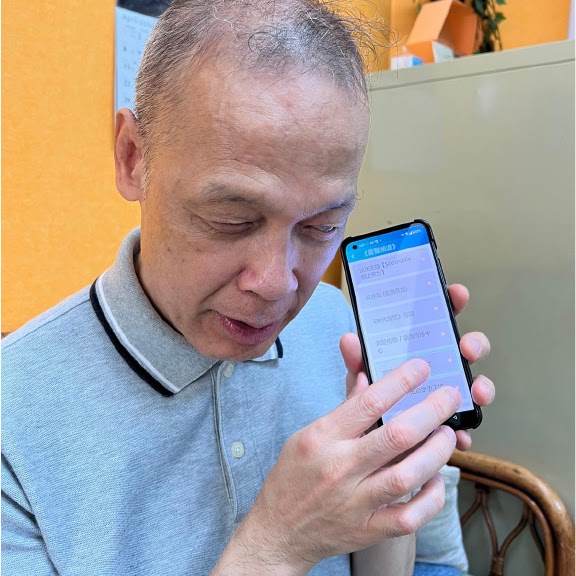
Since its official launch in 2023, the “CMVIP Voice” app has received much positive feedback and encouragement from the Centre’s visually impaired members, enabling continuous improvements to better meet their needs and enhance their user experience. Among the beneficiaries are elderly visually impaired individuals who have limited mobility or live alone. Through simple operation on smartphones or tablets, they can now listen to various types of spiritual resources. Those who previously seldom left their homes can reconnect with the faith community, creating a synergistic effect in shepherding and caring for visually impaired believers.
Today, users of the “CMVIP Voice” app span the globe, including Chinese-speaking visually impaired members in Hong Kong, mainland China, and overseas regions such as Macau, Canada, the United Kingdom, and the United States. They are delighted to be able to listen to the Bible and spiritual books anytime, anywhere, free from geographical or time constraints. This has brought them closer to the Vision Blessings Centre, uniting hearts in the effort to advance the gospel of the kingdom. To better serve visually impaired individuals, we have introduced updates over the past year, including new features such as the “Spiritual Audio Channel,” “Mandarin Channel,” and the upcoming “Hymn Channel.” By God’s grace, the app has gained support from several pastors and Christian organizations, who have granted permission or waived copyright fees for sermon recordings, topical seminars, gospel radio programs, hymns, and more, making these resources available to visually impaired members and nurturing their spiritual growth.
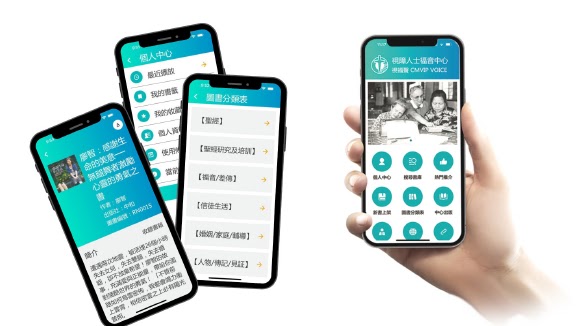
For visually impaired individuals, listening to the Bible and spiritual books through “CMVIP Voice” app is a significant shift from the previous methods of borrowing braille books or audiobook CDs. It eliminates mailing delays and allows for repeated listening, aiding in deeper comprehension of the materials. The app also includes features such as book search, bookmarking, and favorites, making it easier for users to locate, play, and mark preferred content. Additionally, a “playback speed” function allows adjustment to 1.5x or 2.5x speed to accommodate their preference for faster listening. As the app’s content continues to expand and update, more visually impaired individuals are downloading and using it, making it one of the practical tools for their spiritual enrichment.
The year 2024 marks the 45th anniversary of the Gospel Centre for the Visually Impaired! Moving forward, in addition to continuing to select spiritual books and produce “audiobooks” for visually impaired individuals, we will explore the use of “Text-to-Speech” technology to accelerate and advance the production of audiobooks, bringing greater spiritual benefit to more visually impaired believers.
Dear fellow brothers and sisters in Christ, will you join us in praying for the visually impaired to receive the blessings of the gospel? Let us continue to pray for the Vision Blessings Voice app—for technical support, recording personnel, and operational funding—and trust our Heavenly Father to provide and watch over every need.
Chow Suk Lai (Director, Gospel Centre for the Visually Impaired)
Wong Tak Ka (Library Supervisor, Gospel Centre for the Visually Impaired)
Inheriting Ministry, Revitalizing Resources—Nurturing Believers Through New Media [January 8, 2023 Christian Weekly]
With the rapid advancement of information technology and the unprecedented impact of the pandemic, in-person gatherings were once forced to pause. Looking ahead, whether in evangelism or interpersonal relationships, we will increasingly rely on new media. This issue of our publication features interviews with the “Gospel Centre for the Visually Impaired” and “Christian Communications and Publishing Ministry.” The former has developed a tailored mobile app for visually impaired individuals, breaking through physical limitations to enable access to spiritual resources anytime, anywhere. The latter, formerly known as Christian Communications Ltd., has established a new organization to shepherd believers using innovative technologies in response to the lifestyles of the new generation. Indeed, new media is merely a vessel; the key to effective ministry lies in sustaining creativity and responding to the needs of the times in appropriate ways.
Breaking Through Barriers—New Media Empowers Ministry Development
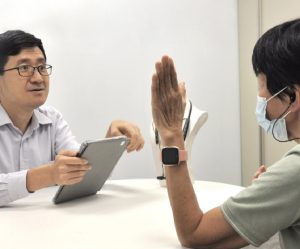
Developing new media is an inevitable trend, but for the visually impaired, even with the accessibility features available on smartphones, browsing websites often poses challenges. Moreover, most mobile applications on the market are designed for sighted individuals, making them even more difficult to operate. “Even with accessibility settings enabled, if an app contains many images or relies on dynamic functions like swiping, we simply cannot use it… We have to try downloading every app, and if it still doesn’t work, we have no choice but to give up,” shared Ms. Ng and Mr. Chow, visually impaired staff members of the Gospel Centre for the Visually Impaired, with a sense of resignation.
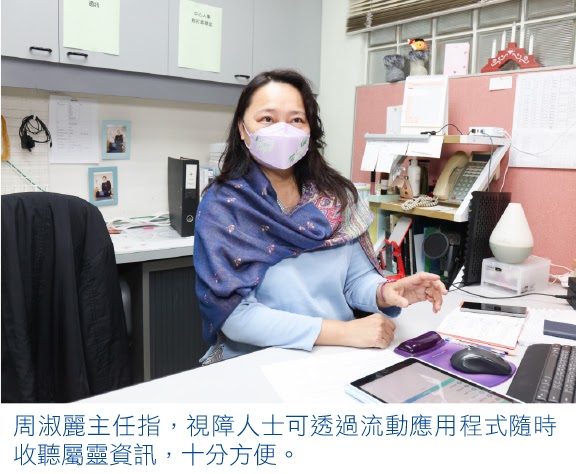
If operating mobile applications is already difficult, accessing online Bible and spiritual resources becomes even more challenging. They pointed out that most e-books available today are text-based and lack audio functionality. Even though there is a wide variety of spiritual books, Christian visually impaired individuals are often unable to use them. As a result, many opt to borrow braille books, spiritual audiobooks on tape, or CDs of Bible studies and topical lectures. However, due to limited borrowing options and the time required to travel, this method remains highly inconvenient. To enable them to listen to the Word of God from the comfort of their homes, the Gospel Centre for the Visually Impaired spent years planning and finally launched “Vision Blessings Voice” in November last year—the first mobile application in Hong Kong’s Christian community specifically designed for the visually impaired.
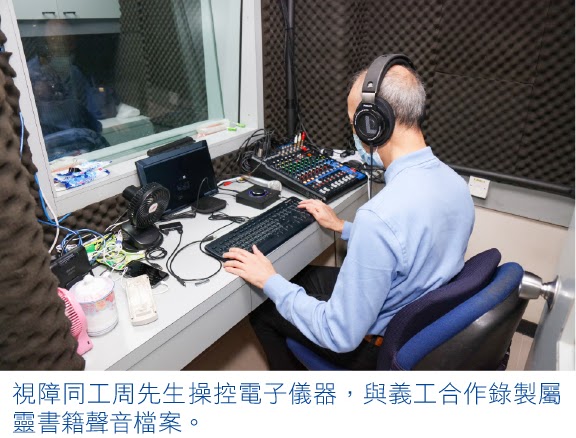
Ms. Chow Suk Lai, Director of the Gospel Centre for the Visually Impaired, noted that with the advancement of technology, many visually impaired individuals now own smartphones, which prompted the decision to develop the “Vision Blessings Voice” app. After countless refinements and the help of volunteers recording audio, the app now contains approximately 100 spiritual books and Bible audio files. Its interface and operations are tailored for the visually impaired and are available for download and listening by the Centre’s members. “In the past, we had to specially print braille books and mail them to visually impaired individuals overseas, a process that took an extremely long time,” she explained. Now, with a smartphone in hand, visually impaired individuals can listen to spiritual resources anytime, anywhere. Moreover, since the content is recorded in Cantonese, it feels more familiar and accessible.
In addition to creating new initiatives, making good use of existing resources can also benefit and nurture believers. For example, the Zoom application has become widely used by believers during the pandemic for participating in fellowship gatherings, Sunday school, and even meetings—and visually impaired individuals are no exception. As long as they familiarize themselves with the button placements, they can operate Zoom just like anyone else. However, elderly individuals and those without smartphones face difficulties joining. Ms. Chow pointed out that joining a Zoom meeting does not necessarily require an internet connection. Even with a landline telephone, one can easily join by dialing the meeting number and password. For elderly individuals who still struggle with the process, she can serve as a “bridge,” using the built-in teleconference feature to connect them to Zoom meetings. She shared that this method has been used in the past to livestream events such as the Hong Kong and Kowloon Revival and Bible Study Conference and weekly book sharing sessions via Zoom. Whether visually impaired individuals have smart devices or not, they can all partake in these spiritual feasts with great convenience.
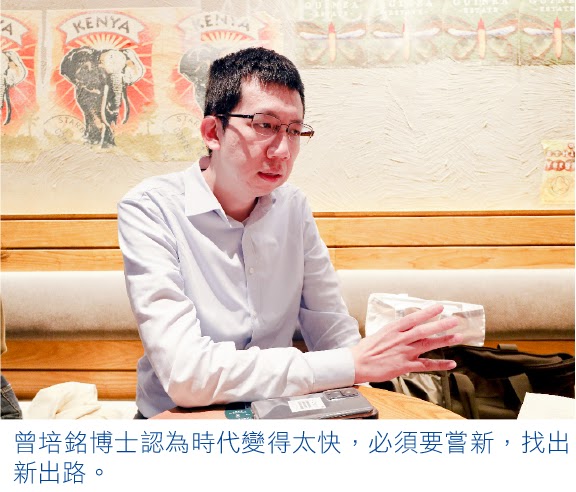
Breaking the Old, Establishing the New — Brand Revitalization to Inherit and Communicate
While many organizations use new media to support their existing ministries, Christian Communications Ltd. has chosen a different path—brand revitalization. Breaking with the old and establishing the new, it has reestablished itself as “Christian Communications and Publishing Ministry.” The name change clearly reflects its determination to embrace transformation.
“People on the subway used to read newspapers; now they watch videos on their phones,” said Dr. Tsang Pui Ming, General Director of Christian Communications and Publishing Ministry, highlighting the rapid changes of the times. With the widespread adoption of smartphones and the internet, print media is no longer the primary medium, prompting the organization to reinvent itself as “Christian Communications and Publishing Ministry.” Dr. Tsang shared that over a century ago, Rev. Robert A. Jaffray founded Christian Communications Ltd., using the latest printing technology of the time to spread the Word of God through print media. Today, with brand revitalization emphasizing “beyond words,” the aim is to carry forward the spirit of the pioneers, continuing the ministry’s legacy and operations—not only staying relevant to the times but also keeping pace with technological advancements, ensuring that the Word reaches people through the most widely accessed mediums of today.
As an organization with over a century of history, Dr. Tsang openly acknowledges that many historical books and documents have deteriorated. Therefore, efforts to digitize past publications, articles, photographs, and audiovisual sermons—such as *The Bible Newspaper* and videos of sermons by Rev. Philip Teng—have been accelerated and made freely available online.
He believes that opening these archives helps believers understand the organization’s history and see how Christians across generations have witnessed to the Lord, faithfully carrying out the mission entrusted by God in different times and contexts. It also allows learning from the past to respond to the present. “Rev. Philip Teng’s teachings in the 1980s on how to respond to the times, or Dr. Simon Wan’s 1990s series ‘Being a Spiritual Person,’ addressed issues such as emigration and identity—topics that remain deeply relevant today. Thus, this is not merely about digitizing old materials; the spiritual quest of the 1980s closely resembles that of today.”
As an organization with over a century of history, Dr. Tsang openly acknowledges that many past books and documents have deteriorated, prompting accelerated efforts to digitize and make freely available online historical publications, articles, photographs, and audiovisual sermons—such as *The Bible Newspaper* and videos of sermons by Rev. Philip Teng. He believes that opening these archives helps believers understand the organization’s history and witness how Christians across generations have testified to the Lord, faithfully fulfilling the mission entrusted by God in different times and contexts. It also allows learning from the past to address the present: “Rev. Philip Teng’s teachings in the 1980s on responding to the times, or Dr. Simon Wan’s 1990s series ‘Being a Spiritual Person,’ addressed issues like emigration and identity—topics still deeply relevant today. So this is not merely about digitizing old materials; the spiritual quest of the 1980s closely parallels that of today.”
However, the restoration process is far from easy. For instance, some audio tapes are nearly 40 years old and have become fragile and brittle. Staff must first clean them to remove mold, then use specialized equipment to convert them into digital files, followed by post-production audio restoration using software. He notes with a smile that due to budget constraints—having to achieve the most with minimal resources—staff have had to teach themselves skills like video editing and audio restoration through YouTube. He himself has also taken part in editing, believing that true inheritance requires hands-on involvement.
In its core publishing work, Christian Communications and Publishing Ministry invites online writers to contribute to e-books. “Writers of the new generation have different perspectives; their interpretations of faith are more grounded, helping to enrich the faith as a whole.” The ministry also utilizes platforms such as YouTube, social media, and podcasts for promotion. For example, its YouTube channel has launched new programs, including not only book-sharing sessions but also content on cultural heritage, such as interviews with brassware workshops or explorations of movable-type printing techniques.
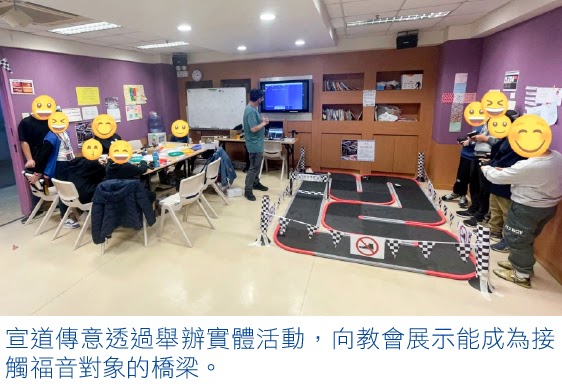
Recently, the ministry has even ventured into physical events. On the past Christmas Eve, it organized a “Market × Racing” event. Dr. Tsang hopes to demonstrate to churches that the ministry can serve as a bridge, helping them engage with evangelistic audiences in more diverse ways while stepping into the world to understand the needs of their audience. He emphasizes that the times are changing too quickly, and it is essential to experiment—even if attempts fail, they can at least provide valuable experience for future generations. “Someone must take the first step. I would describe it as sailing or exploration; we might discover another path along the way. Sticking to the familiar may feel safe, but is that enough, especially when the world is transforming so rapidly? ‘Communicating meaning’ requires observing the trends of the younger generation.”
Angel Heart "Let the Gospel Open the Eyes of the Heart" [March 2016]
Here is a group of visually impaired individuals who, despite physical limitations, are able to see the light because God’s love has opened the eyes of their hearts, allowing them to perceive the light of life. Located in Shek Kip Mei, the “Gospel Centre for the Visually Impaired” (hereafter referred to as the “Vision Blessings Centre”) has long provided support to these visually impaired individuals. By producing and translating various versions of braille Bibles, gospel magazines, spiritual books, theological resources, and spiritual audiobooks, the Centre nurtures and trains the spiritual lives of visually impaired believers and brings the gospel to more visually impaired individuals who have yet to believe, enabling them to open their spiritual eyes and see the light.
According to Report No. 62, “Persons with Disabilities and Chronic Diseases,” published by the Hong Kong Census and Statistics Department in December 2014, there were 174,800 registered visually impaired individuals, accounting for 2.4% of Hong Kong’s total population. Celebrating its 35th anniversary, the Vision Blessings Centre was founded by Sr. Mary Lange and a group of passionate visually impaired individuals, along with Christian volunteers. Originally named the “Blind Gospel Literature Centre,” the Centre’s Director, Mrs. Chan Hung Pik Yue, explained, “The organization initially focused on producing books. Later, beyond the library, we gradually expanded to organize various activities and support church ministries, leading to the name change to ‘Gospel Centre for the Visually Impaired.'”
Barrier-Free Ministry
Director Chan, who began serving at the Vision Blessings Centre in 1998, once studied at a theological seminary, which helped her realize that where one works is not as important as having a clear direction and God’s calling. “I have determined my direction—to bring people before God.” Through courses, activities, and gatherings, the Vision Blessings Centre brings heavenly blessings to visually impaired individuals. Though they cannot see with their eyes, God’s love can touch every heart. Director Chan has witnessed God at work in their lives: “A lady who volunteered at the Centre for over twenty years expressed her desire to believe in Jesus, so I shared the faith with her. We not only hope for volunteers to serve visually impaired individuals but also for their own lives to be transformed. These moments give me the motivation to persevere and hold onto this God-given calling and inspiration.”
After the Billy Graham Crusade in the 1990s, under the initiative of German missionary Sr. Maria Lange, the “Alumni Gospel Ministry of Ebenezer School & Home for the Visually Impaired” and the “Gospel Centre for the Visually Impaired” jointly established the “Visually Impaired Evangelism Committee” to coordinate and plan evangelistic work for the visually impaired. Through Evangelism Explosion training, follow-up discipleship training, fellowship gatherings, and more, the Vision Blessings Centre nurtures and equips visually impaired believers, affirming the value of their lives and preparing them to serve as skilled soldiers in God’s work.
Unseen Challenges
According to Article 27, “Work and Employment,” of the United Nations Convention on the Rights of Persons with Disabilities, persons with disabilities have the right to work on an equal basis with others, including the opportunity to make a living by freely choosing or accepting work in an open, inclusive, and accessible labor market and work environment. However, for visually impaired individuals in Hong Kong, despite their desire to achieve self-reliance through work, job opportunities and choices remain limited.
“While Hong Kong people generally show greater acceptance of the visually impaired, their understanding of their capabilities remains relatively low.” Director Chan noted that many visually impaired individuals, though unable to see, are not hindered in their ability to work. “As sighted individuals, we need to place greater trust in them and give them opportunities to try. For example, in churches, visually impaired individuals can serve as choir members, teach Sunday school, lead worship, and more, allowing them to explore their potential and live more freely.” Director Chan also pointed out that marriage poses challenges for visually impaired individuals. If any family member opposes or is unwilling to accept them, the resulting psychological pressure and issues can be significant.
New Hope Program
Unlike general centers and organizations for the visually impaired, the Vision Blessings Centre focuses on gospel ministry. Under its “Life Care and Referral Services,” the Centre proactively visits and contacts visually impaired individuals through phone calls to provide help and comfort to those in distress. The “New Hope Program” pairs experienced visually impaired believers as mentors to guide newly visually impaired individuals through life and skill challenges, offering mutual support and sharing. The program covers four areas of learning: 1. Orientation and Mobility, 2. Daily Living Skills, 3. Braille Learning, and 4. Computer Operations.
Voices from the “New Hope Program” Members
Sau Mui: “Though I cannot see, I know God has always guided me. Through the inspiration of John 3:16, I help others as someone who has walked a similar path. Through the program, I tailor my teaching to the individual needs and daily lives of newly visually impaired individuals, sharing my experiences and faith with them. God has also made me feel surrounded by many angels who comfort and love me. I hope that when people face difficulties, they do not dwell on them or retreat, because there are always more solutions than problems—they can be overcome.”
Yvonne: “At first, my family struggled to accept my condition, but I wanted to prove through my actions that even if I were to lose my sight, I would strive to persevere. By joining this program, my mentor communicates with me, providing someone to talk to and teaching according to my needs and preferences. When my vision began to deteriorate and I felt down, God helped me through this verse: ‘I have come that they may have life, and have it to the full’ (John 10:10). Peace and joy can easily be overshadowed, but God’s promises remain forever. Knowing that God is the giver of life, I strive to make better use of my life, believing that He has a plan to fulfill through me.”
Through the “New Hope Program,” the lives of visually impaired individuals are strengthened in the Lord. The Centre also refers newly believing visually impaired individuals to local churches for worship and provides follow-up care through visits. For those who have yet to believe, the Centre offers one-on-one courses, giving them opportunities to build community life in small groups. For family members of visually impaired individuals, Director Chan offers the following advice: “Pay attention to home layout and ensure items are returned to their designated places. For visually impaired individuals, items need fixed positions so they can easily find them. Many believe that only the visually impaired individual needs to adapt and learn, but family members must also learn, support, and communicate together.”
Beyond assisting visually impaired individuals in daily living, training, and courses, the Vision Blessings Centre also produces braille worship programs and Bible materials for churches with visually impaired members. Director Chan stated, “The Vision Blessings Centre’s philosophy is not to encourage visually impaired individuals to attend churches exclusively for them. Since they only have visual impairments and are otherwise fully capable, we hope and encourage them to interact and integrate with sighted brothers and sisters, participating in regular church gatherings. We also provide support and tools for visually impaired individuals in various churches.”
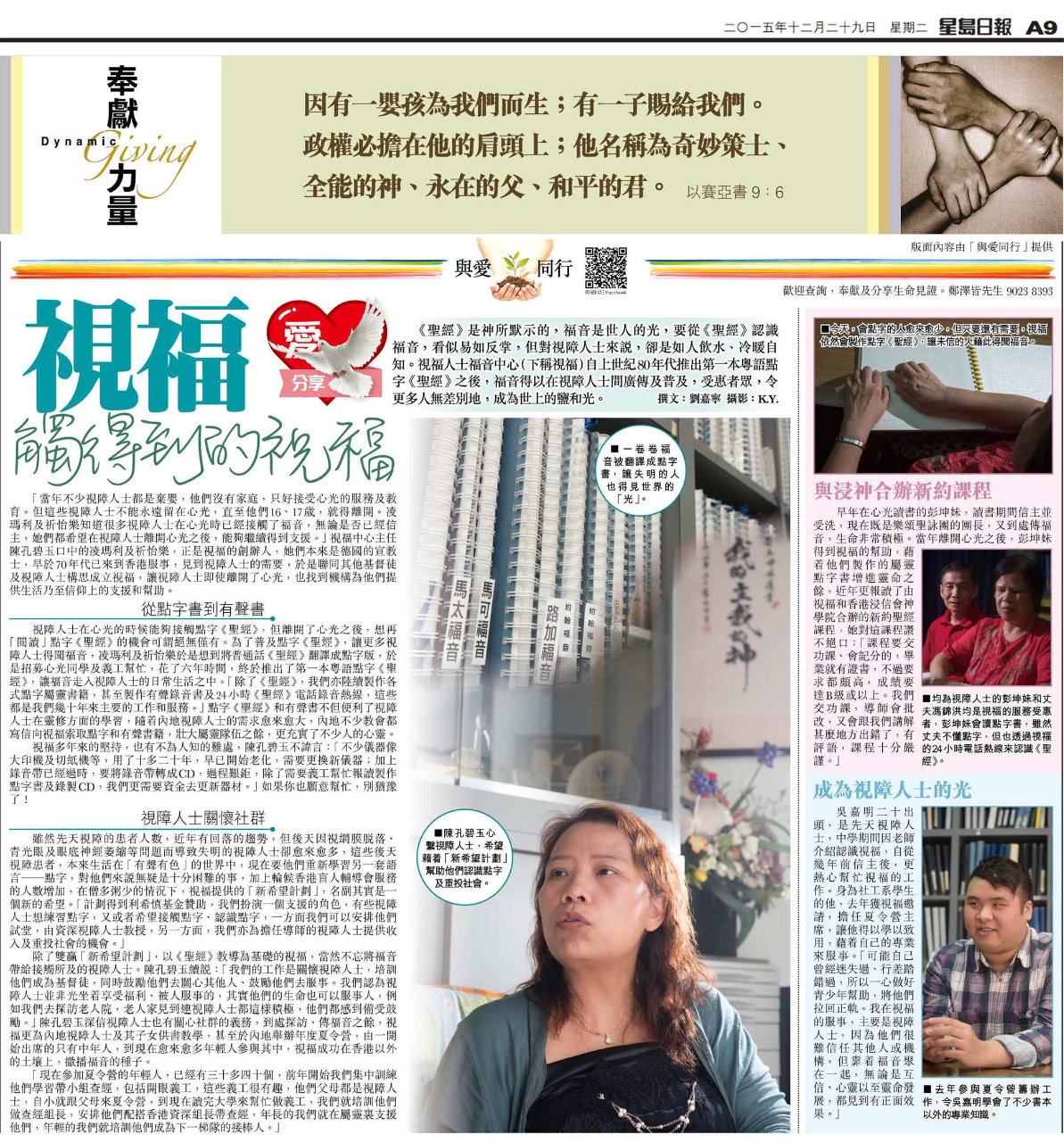
Sing Tao Daily A9 【"Touchable Blessings: The Gospel Centre for the Visually Impaired"】 [Tuesday, December 29, 2015]
“In the past, many visually impaired individuals were abandoned infants. Without families, they could only receive services and education from Ebenezer School & Home for the Visually Impaired. However, they could not stay at Ebenezer forever—once they reached 16 or 17 years old, they had to leave. Sr. Maria Lange and Sr. Gisela Krieger knew that many visually impaired individuals had already encountered the gospel during their time at Ebenezer. Whether they had come to faith or not, they hoped these individuals would continue to receive support after leaving Ebenezer.” The Sr. Maria Lange and Sr. Gisela Krieger mentioned by Mrs. Chan Hung Pik Yue, Director of the Gospel Centre for the Visually Impaired, are the founders of the Centre. They were German missionaries who came to serve in Hong Kong as early as the 1970s. Witnessing the needs of the visually impaired, they collaborated with other Christians and visually impaired individuals to establish the Centre, ensuring that even after leaving Ebenezer, visually impaired individuals could find an organization to support them in both daily life and faith.
[From Braille Books to Audiobooks]While at Ebenezer, visually impaired individuals had access to braille Bibles. However, after leaving, opportunities to “read” braille Bibles became exceedingly rare. To make braille Bibles more accessible and enable more visually impaired individuals to hear the gospel, Sr. Maria Lange and Sr. Gisela Krieger conceived the idea of translating the Mandarin Bible into braille. They recruited Ebenezer alumni and volunteers, and after six years of effort, produced the first Cantonese braille Bible, bringing the gospel into the daily lives of visually impaired individuals. “In addition to the Bible, we gradually produced various braille spiritual books. We also created audiobooks and a 24-hour Bible telephone hotline—these have been our primary works and services over the decades.” Braille Bibles and audiobooks not only facilitated the spiritual growth of visually impaired individuals but also, as demand from mainland China increased, many churches wrote to the Centre requesting braille and audio materials. This not only expanded the spiritual community but also enriched countless hearts.
The Centre’s persistence over the years has not been without challenges. Mrs. Chan openly admits, “Many instruments, such as large printers and paper cutters, have been used for over ten or twenty years and have begun to age, requiring replacement. Additionally, audio tapes are now outdated, and converting them to CDs is a daunting process. Beyond needing volunteers to assist in producing braille books and recording CDs, we also require funds to update our equipment.” If you are willing to help, do not hesitate!
[Caring for the Visually Impaired Community]While the number of individuals with congenital visual impairments has shown a declining trend in recent years, the number of those who become visually impaired later in life due to conditions such as retinal detachment, glaucoma, and optic nerve atrophy is increasing. These individuals, who once lived in a “vivid and colorful” world, now face the challenge of learning a new language—braille—which is undoubtedly difficult for them. Moreover, with rising demand for services from the Hong Kong Society for the Blind, the Centre’s “New Hope Program” has become a genuine new hope in a situation of scarce resources. “Sponsored by the Lee Hysan Foundation, we play a supportive role. Some visually impaired individuals wish to practice braille or simply learn about it. On one hand, we can arrange trial sessions taught by experienced visually impaired individuals. On the other hand, we also provide income and opportunities for these visually impaired instructors to reintegrate into society.”
Beyond this win-win “New Hope Program,” the Centre, which is grounded in Biblical teaching, naturally remains committed to bringing the gospel to visually impaired individuals within its reach. Mrs. Chan adds, “Our work involves caring for visually impaired individuals, training them to become Christians, and encouraging them to care for others and engage in service. We believe visually impaired individuals are not merely passive recipients of welfare; their lives can also serve others. For example, when we visit elderly homes, the elderly are encouraged to see visually impaired individuals living so positively.” Mrs. Chan firmly believes that visually impaired individuals also have a duty to care for the community. Beyond visits and evangelism, the Centre also supports mainland visually impaired individuals and their children with educational resources and even holds annual summer camps in mainland China. Initially attended mostly by middle-aged individuals, these camps now attract an increasing number of young people, successfully sowing the seeds of the gospel beyond Hong Kong.
“Today, there are already thirty to forty young people participating in the summer camps. Starting two years ago, we focused on training them to lead small group Bible studies, including sighted volunteers. Interestingly, many of these volunteers are children of visually impaired parents. They grew up attending the camps with their parents and, after completing university, now return as volunteers. We train them to become Bible study leaders, pairing them with experienced leaders from Hong Kong. For the older participants, we provide spiritual support, while for the younger ones, we train them to become the next generation of leaders.”
[Collaboration with Hong Kong Baptist Theological Seminary for New Testament Course]Peng Kun Mui, who studied at Ebenezer in her early years, came to faith and was baptized during her time there. She now serves as the leader of the Joyful Praise Choir and actively shares the gospel wherever she goes. After leaving Ebenezer, Peng Kun Mui received help from the Centre. Through the spiritual braille books produced by the Centre, she grew in her faith. In recent years, she even enrolled in a New Testament Bible course jointly organized by the Centre and the Hong Kong Baptist Theological Seminary. She speaks highly of the course: “The course requires assignments and is graded. Graduates receive a certificate, but the standards are quite high—grades must be B or above. When we submit assignments, the instructors provide feedback and explain where we went wrong. The course is very rigorous.”
Photo: Both Peng Kun Mui and her husband, Fung Kam Hung, are visually impaired and have benefited from the Centre’s services. Peng Kun Mui reads braille books, and although her husband does not know braille, he accesses the Bible through the Centre’s 24-hour telephone hotline.
[Becoming a Light for the Visually Impaired]Ng Ka Ming, in his early twenties, is congenitally visually impaired. He was introduced to the Centre during his secondary school years by a teacher. Since coming to faith several years ago, he has become increasingly passionate about helping with the Centre’s work. As a social work student, he was invited last year to serve as the chairperson of the summer camp, allowing him to apply his professional knowledge in service. “Perhaps because I once lost my way and made mistakes, I am committed to helping young people and guiding them back to the right path. My service at the Centre focuses on visually impaired individuals, as they often find it difficult to trust others or organizations. However, through the gospel, we come together, and whether in mutual trust, emotional well-being, or spiritual growth, we see positive effects.”
Photo: Participating in the summer camp organizing work last year allowed Ng Ka Ming to gain professional knowledge beyond textbooks.